Before we look to the future of human services, it is helpful to look at the journey we have been on and where we are at now.
This section provides an overview of human services in Australia, including quality of services, delivery models, historic shifts and recent trends.
Human services in Australia
Human services help improve the lives of Australians, supporting individuals, families and communities by addressing their health, education, housing, employment, welfare and care needs.
The Australian Government is responsible for delivering a wide range of human services working in partnership with the state and territory governments, non-government organisations and community leaders.
Government departments including the Department of Health, Disability and Ageing, Department of Education, the Department of Social Services, Services Australia and the Department of Employment and Workplace Relations are leaders in service delivery.
The Australians using our human services
Most Australians use human services at some stage in their life. These services can be life changing, helping people through big events such as having a baby, getting an education, upskilling to secure a job, finding safe housing, recovering from an illness and accessing end-of-life care. Some Australians use universal services intermittently and some of our most vulnerable groups require ongoing support.
Around 70% of Australians use a government service each year.3 In 2025, 5.3 million Australians (aged 16 and over) received income support payments.4 People in remote and regional areas have higher rates of service uses and Aboriginal and Torres Strait Islander people are overrepresented for some services.
The quality of our human services
Australia performs well in international comparisons of human services quality and welfare outcome measures (Figure 2). For example, among OECD countries, Australia ranks in the top 5 for quality of health care, person-centred care, co-ordination of care and physical health.5
As well as measuring outcomes, the Australian Government also assesses the performance of human services against measures like customer satisfaction, trust, timeliness, accuracy and access. For example, Services Australia publishes a summary of its performance every year in its annual report. In 2023-24, Services Australia achieved a 79.1% customer satisfaction rating, 97.8% on administrative correctness of payments and 99.9% on digital access.6
There are significant differences in satisfaction with human services across socio-economic and demographic indicators.7 Satisfaction and trust in human services are linked to people’s individual characteristics, reasons for accessing services and service access experiences. On average, women trust public services less than men (59% compared to 66%) and people aged 18-34 have the highest level of trust (70%).8
Figure 2: International comparison of wellbeing and welfare outcomes9
83.2 years
Life expectancy
The life expectancy of Australians (at birth) is well above the OECD average of 81 years.
51.4%
Educational attainment
The proportion of Australians aged 25 to 64 with a tertiary qualification is above the OECD average of 40.7%.
3.7%
Unemployment rate
Australia’s unemployment rate for people aged 15 to 64 is below the OECD average of 5%.
81.8%
Housing affordability
On average, Australian households retain 81.8% of their income after housing costs, slightly above the OECD average of 80%.
The cost of our human services
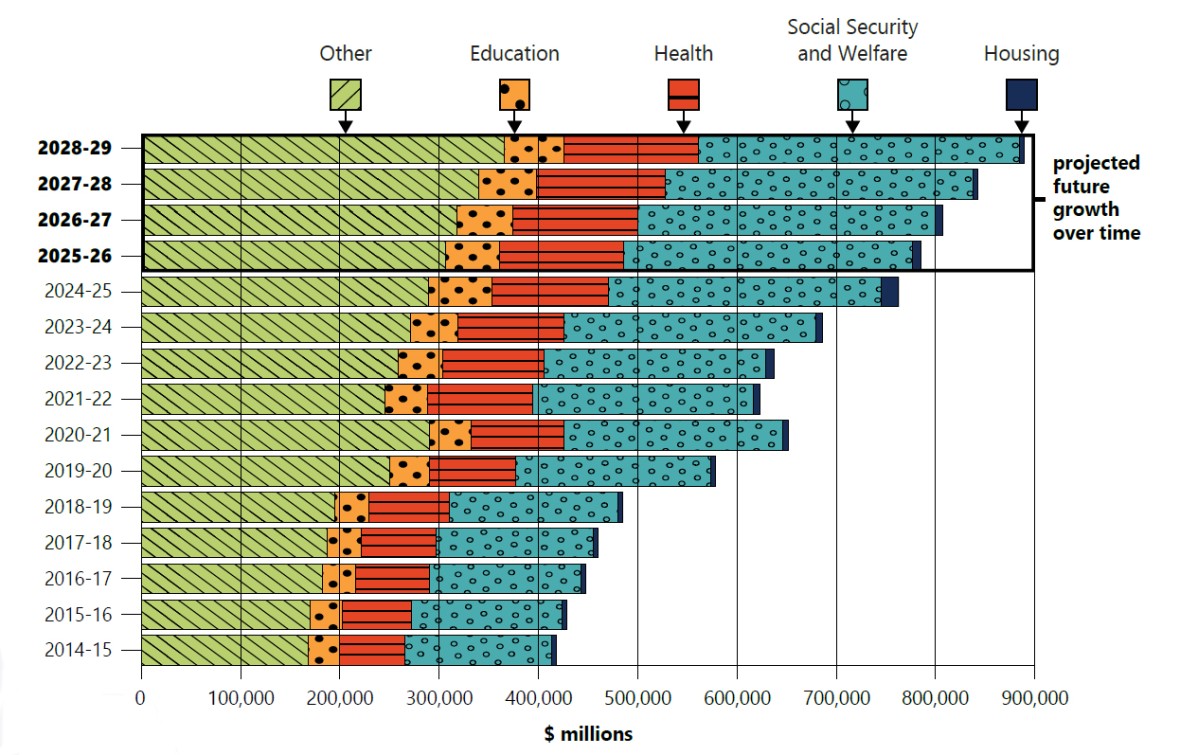
The cost of human services is significant. In the 2024-25 Australian Government Budget, human services expenditure included $274.9 billion on social security and welfare, $117 billion on health, $63.5 billion on education and $18.1 billion on housing and community amenities.10 As illustrated in Figure 3, these costs are projected to grow over time.
Figure 3: Government expenditure over time11
The delivery of human services
There are four human service delivery models currently in use in Australia, as summarised in Table 1.
Services Australia is the Australian Government’s primary provider of direct services, payments and subsidies. Services Australia delivers its services digitally, through myGov, and in-person through 318 services centres across Australia, including 16 in remote locations. Its key programs are Centrelink (payments mechanism), Medicare (payment subsidy), child support and crisis support (including severe financial hardship and disaster recovery). Services Australia also provides specialist social work services to people who have complex needs, in particular, victim-survivors of domestic violence, unsupported young people and people at risk of suicide. myGov is one of the most heavily used digital platforms in Australia, providing a centralised entry point for people to access critical government services. There are over 26 million active myGov accounts in Australia and more than 782,000 sign ins to the platform per day.12
Australia’s health system is an example of a hybrid service delivery model. Health services in Australia are delivered by government and non-government providers in a range of settings, including public hospitals, primary and community health, and mental health service settings. Medicare and public hospitals are the foundation of universal health care in Australia. Primary Health Networks manage primary care in their regions through collaboration, commissioning service providers and capacity building, in line with Australian Government priorities.13
Outsourced delivery models are used for government service areas such as employment, disability, childcare and the Humanitarian Settlement Program. Each have a different funding and operating model. For example, the National Disability Insurance Scheme (NDIS) provides funding to eligible people with disability to purchase their disability-related supports from a provider market. The government regulates the provider market through an independent regulatory authority, the NDIS Quality and Safeguards Commission, and by setting price limits for supports and services.
Community-led human service delivery models are centred on the experiences and needs of a particular community. Government provides more open-ended funding to a community organisation or a coalition of community organisations to design and deliver services. These initiatives usually arise out of local, community-driven endeavours. For example, Stronger Places, Stronger People is a government initiative, led by the Department of Social Services, which provides the authorising environment and investment for community-led social impact projects that were started as local endeavours.14 There are also 145 Aboriginal Community Controlled Health Organisations across Australia that deliver health services to Aboriginal and Torres Strait Islander peoples. This primary health care network has a footprint of more than 550 sites and provides care for almost 410,000 people.15 The national leadership body, the National Aboriginal Community Controlled Health Organisation, engages with government on policy and budget matters and advocates for community-developed solutions. Programs are funded by both federal and state governments.16
Table 1: Human service delivery models
| Delivery model | Objective | Description | Funding |
|---|---|---|---|
| Direct | Fast and efficient delivery directly to Australians | Services payments and subsidies are provided directly to Australians by the Commonwealth government through digital and face to face channels. Examples of direct services, payments and subsidies include: income support, study payments, Medicare, child support payments, Veterans payments, childcare subsidies, carers payments, retiring and ageing payments. |
|
| Hybrid | Strength-based partnerships to deliver quality services | Partnerships across government and community to deliver a range of tailored services. Can include Commonwealth, state and territory and local governments, the private sector and communities. Examples of hybrid services include: health, education, family and domestic violence services and homelessness services. |
|
| Outsourced | Consumer choice drives competition for effective and efficient service delivery | Human service delivery is contracted out to external providers that may be not-for-profit or for-profit organisations. Users purchase or use services from providers that are quality controlled and held accountable by government. Examples of outsourced services include: employment services, childcare, disability through NDIS, humanitarian settlement program, adult migrant English program |
|
| Community-led | Communities decide and lead the approach to human service delivery in their location | Community organises itself to partner with government and others to address complex, interconnected social issues. Examples of community-led services include: collective impact initiatives, Logan Together, multicultural services, Men’s Shed, social enterprise, Chatty Cafes, and Aboriginal Community Controlled Health Organisation. |
|
Historic shifts and recent trends in human service delivery
Human service delivery in Australia has evolved from the historical direct service provision by Commonwealth departments and agencies (illustrated in Figure 4). The major shifts in human service delivery are a move to market-based approaches, the transformation to digital service delivery, place-based approaches, and a focus on outcomes for people.
Figure 4. Timeline of changing approaches to government human service delivery
Emergence of New Public Management (NPM) concepts.
Growing appeal of market efficiency and private‑sector approaches amid perceived government inefficiency.
Creation of Centrelink (1997), outsourcing of employment services, and Financial Management and Accountability Act 1997 (Cth).
Consolidation of NPM principles: governments steer rather than deliver, using business‑like contracting for efficiency and transparency.
Royal Commissions and reviews highlight challenges and opportunities in service delivery.
Competitive processes and efficiency mature, shaping governance and performance measurement.
Public Governance, Performance and Accountability Act 2013 (Cth) replaces the 1997 Act, reinforcing accountability for resource use.
Despite efficiency gains, gaps persist; broken markets drive innovation and place‑based services to address local challenges.
The move to market-based approaches
The move to outsource human service delivery and create a market-based environment was motivated by a pursuit of efficiency and the desire to empower the service recipient to choose.17 This new approach to public sector management was known as New Public Management and aimed to apply private sector practices to government. New Public Management arose out of a belief in the efficacy and efficiency of markets and economic rationality. Reviews of government services have reiterated the expectations that introducing greater competition, contestability and informed user choice could improve the efficiency of services.18
The move to market-based approaches for some human services has delivered positive outcomes, particularly where a universal service offering is appropriate.19 In market-based approaches, competition is seen as driving innovation, improving efficiency and creating incentives to be more responsive to people’s needs. The realisation of the benefits of market-based approaches are clearest when people have straightforward and quantifiable needs.
People with more complex or nuanced needs can see poorer outcomes.20 Reviews and evaluations of government services, including Royal Commissions, have highlighted some of these poor outcomes and identified the challenges with implementing a market-based model.21
The shift to digital service delivery
The shift to digital service delivery is ongoing and demonstrating benefits in terms of efficiency, access, and user experience. Well-designed digital services centre on the customer journey, removing complexity and wait times.
The OECD Digital Government Index (2025) ranks Australia among the best performing countries for digital government, with Australia placing second out of the 42 countries assessed.22 From the mid-2010s, Australia invested in digital transformation and e-government development.23 Australians are able to lodge tax returns, apply for and manage income support payments, and access their medical information online through myGov.
Reviews of government digital human services have emphasised the need for user-centred and co-design approaches and a focus on designing services for the user rather than efficiency for government.24 Reviews have also highlighted the importance of avoiding language and conduct that reinforces feelings of stigma and shame and supporting people to make informed choices.25
Place-based approaches
Place-based approaches to human services leverage the strengths, skills, knowledge and experience of local communities to improve responses to complex, local issues. The objective is a collaborative, long-term approach to build thriving communities delivered in place.26 This approach is ideally characterised by partnering and shared design, stewardship, and accountability for outcomes and impacts.27 In a place-based approach, relationships are built between public servants, service providers and members of the community to ensure services help people to navigate the problems in their lives.28
Place-based approaches are usually adopted where there are entrenched, complex social problems to be solved and where universal services have been insufficient to address them. In the context of place-based initiatives, any understanding of place must resonate with the local community, with meaning produced in the actual practices of people, rather than imposed administratively.29
Study – Stronger Places, Stronger People30
Stronger Places, Stronger People is a community-led initiative in partnership with Australian, state and territory governments that is funded until 2029. The initiative seeks to disrupt disadvantage and create a better future for children and their families in 10 Australian communities. These communities work to identify locally tailored and evidence-driven solutions to local problems. Accountability for planning, decision making and outcomes is shared by communities, governments, service providers and investors.
Place-based approaches that enable communities to be part of decision-making requires a commitment of time, strong community leadership and cohesion, and the ability for government and the local community to work together. These approaches take time and commitment but are considered to lead to better outcomes for the community (noting data on outcomes is emergent).31
There are many ways to deliver place-based approaches, with relationships, shared decision-making and ongoing commitment key features of all co-designed activities.32 The National Disability Insurance Agency has articulated that ‘co-design needs to be understood in its broadest sense that includes various ways of co-working’, such as co-planning, co-designing, co-delivering, co-evaluating and co-governance.33
Challenges associated with affordability, scalability, evaluation and knowledge transfer have limited the expansion of place-based approaches in national service delivery systems to date.34
Refocusing on outcomes for people
Historically, the administrative practices within the APS, such as accrual budgeting and annual output targets, were largely focused on quantitative performance management.35 Performance management systems are set up to track expenditure or outputs by providers, rather than outcomes for the people who receive a service.36 The Public Governance, Performance and Accountability Act 2013 introduced increased accountability for the performance of the APS in delivering its purposes, as per government policy.
More recently the Australian Government has established national frameworks to measure welfare outcomes for Australians. For example, the Measuring What Matters Framework, 2023, was established to track our progress towards a more healthy, secure, sustainable, cohesive and prosperous Australia.37 The Measuring What Matters Framework has five wellbeing themes, supported by outcomes measures which will be monitored and tracked over time. Similarly, the National Agreement on Closing the Gap, 2020, which aims to overcome entrenched inequalities experienced by many Aboriginal and Torres Strait Islander people, includes 17 socio-economic outcome targets, so we know whether we are making a difference.38
At an individual level, service providers are now using impact measures to assess outcomes for their service users. For example, Mission Australia measures the impact of their services by collecting client feedback through client surveys at key points on their journey.39