The Australian Government is taking steps to apply safety by design principles into systems reform and design to help reduce systems abuse. This Summary Guidance document (the Summary Guide) gives an overview of how Australian Government agencies can use safety by design principles when reviewing and reforming government systems. By doing this, agencies can make government systems harder for perpetrators of family and domestic violence to misuse, and safer for people who interact with them. The Summary Guide proposes a set of safety by design principles and a phased approach to their application.
For further guidance, agencies can refer to the detailed guide available on the Gender Analysis Community of Practice or contact the Office for Women at OFW-EGBVSystemsSafety@pmc.gov.au.
Definition of safety by design
Safety by design seeks to ensure safety is considered in the design and operation of systems to help stop abuse and harm before they occur. By applying safety by design principles to government systems – from policy design to service delivery – agencies can prevent them from being misused to perpetrate family and domestic violence.
Government systems are diverse and wide ranging, encompassing social services and security, financial, digital, immigration, legal systems and beyond. When systems do not consider safety upfront, perpetrators of family and domestic violence can deliberately misuse or weaponise them to control threaten or harm people—particularly women, children, LGBTQIA+ people, First Nations peoples, people with disability, migrants and refugees, and others with intersecting vulnerabilities.
Safety by design principles
Three core principles underpin safety by design for government systems:
1. Government role
Government systems should work for the best interests of users and uphold human rights.
The burden of ensuring safety should not rest solely on the person using government systems.
Systems should be trauma-informed and accessible across the diverse range of users.
2. User empowerment and autonomy
People using government systems and services should be empowered to make decisions.
The interaction between privacy and safety should be carefully considered.
3. Transparency and accountability
Government should be accountable for and transparent about its approach to safety in systems, including through publicising implementation and outcomes of actions to ensure safety.
A phased approach to embedding safety by design
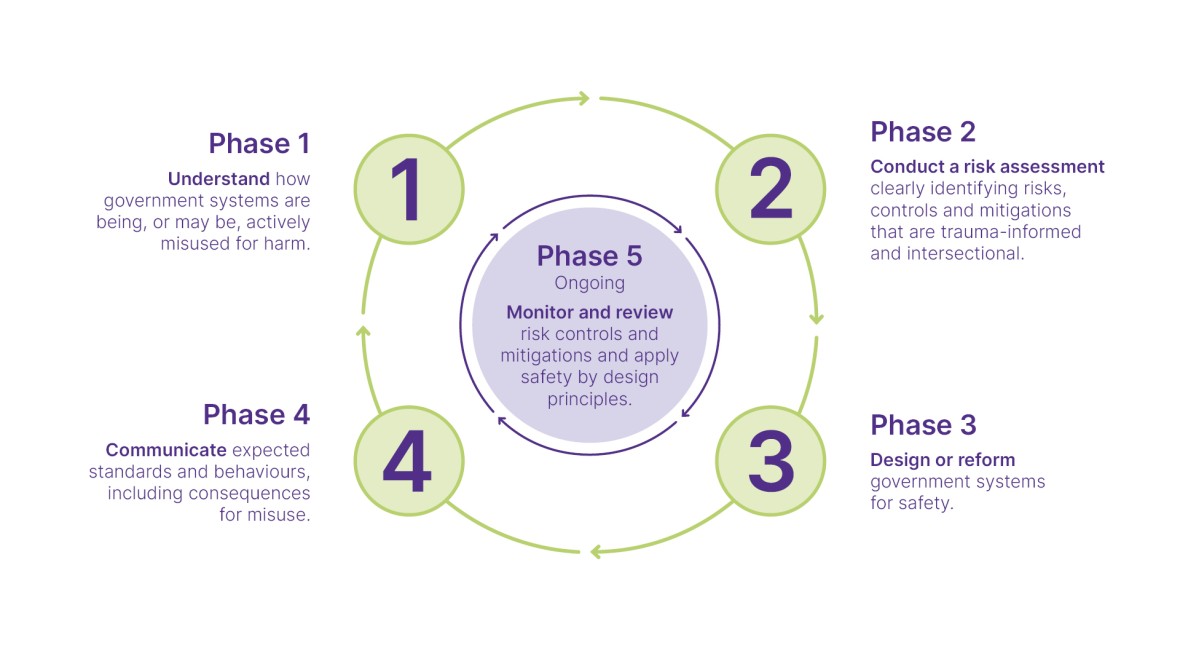
The phased approach below can be applied to systems broadly to prevent abuse, drive perpetrator accountability and change behaviours. Government systems vary widely in their design and operation. Agencies may need to adapt the approach to embed safety by design across different systems. This guidance is not prescriptive. It can and should be adapted to each agency’s particular context.
Phase 1: Understand how government systems are being, or may be, actively misused for harm and how their operation may inadvertently cause harm.
Phase 2: Map the information from Phase 1 into a risk assessment of potential system vulnerabilities, with controls and mitigation strategies in place for high consequence or high likelihood risks.
Phase 3: Consider and put into practice design options to prevent, disrupt and respond to misuse that also address the underlying drivers of gendered violence, as identified through the risk assessment.
Phase 4: Summarise and publicly share actions taken to ensure safety and outline expected duties, responsibilities, behaviours and consequences for misuse of the service systems.
Phase 5: Respond to emerging safety issues – identified by users or responsible agencies – by regularly revisiting the steps above to improve and update systems.